

Candy, especially good home-made candy, is a great way to inject a bit of fun into your every-day life! Sadly, candy making can be seen as technically difficult, or as something only made by generations past. But peanut brittle—with its crisp texture and combination of sweet and salty flavors and rich mouth-feel—is actually one of the easiest candies to make! But don’t let this candy’s simplicity fool you, there’s some serious chemistry going on right under your nose.
For instance, the sugar used in brittle (or nearly any candy making, for that matter) undergoes a process called Sugar Inversion. Applying heat to sugar (table sugar, called sucrose by scientists) causes inversion, the splitting of sucrose into fructose and glucose in liquid form. Then, as the temperature increases, acids accumulate, the color of the sugar darkens, and flavors and aromas become more complex. It’s all very complex chemistry, but luckily for us, it happens whether we know what a reducing reaction is or not! All we need to do is keep track of the temperatures and add things at the right time. Let’s take a closer look.
Sugar Cooking Stages
There are many different stages your syrup will go through as the temperature of a sugar solution rises, and for your recipe to be successful, the final temperature must be measured accurately. Some use the cold water test with sugar cooking by taking a small amount of cooked sugar, dropping it into cold water to test its consistency when set. But this is a pre-technological answer to a very complex problem, and is, at best, haphazard for the novice.
The problem is, while you’re testing the little drop of sugar, the temperature of the sugar in the pan is still rising. Even if you remove it from the heat, carryover cooking (and the exothermic reactions in caramelizing sugars) will continue to increase the temperature while you test. In fact, as the amount of water in the solution decreases, the temperature will begin increasing at a faster pace.
The very best way to check the candy stage is with a high-speed thermometer. Measuring the temperature gives you a direct reading of the sugar concentration, which is just what you want.
The Best Candy Thermometer
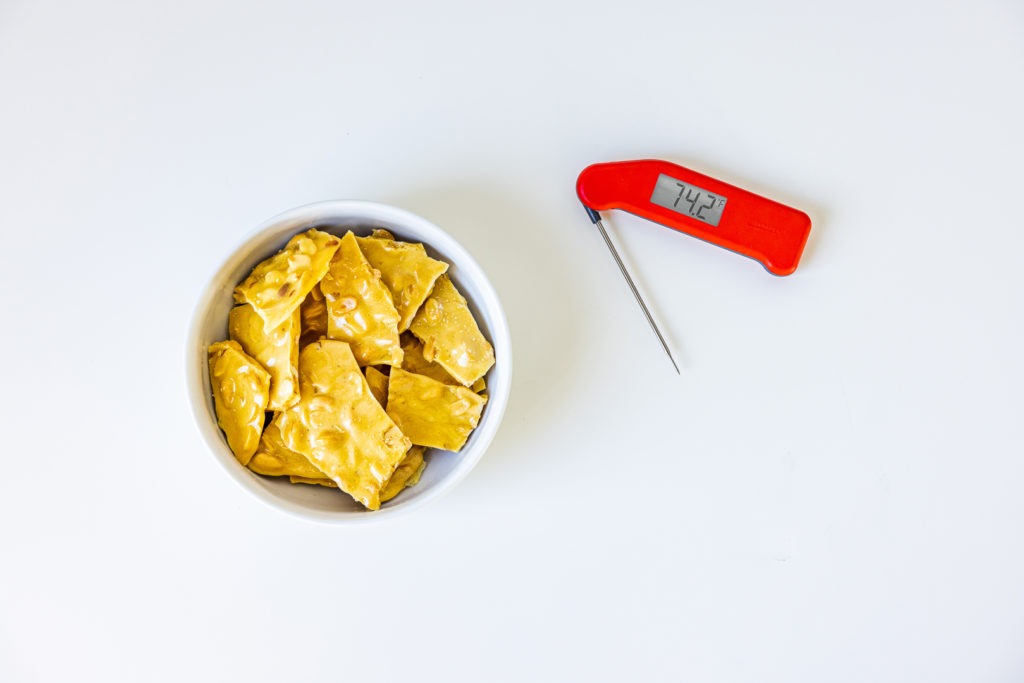
You need to instantly and accurately read the sugar’s temperature. A Thermapen®is always our instant-read thermometer of choice when making candy because of its thermal range, accuracy, and speed. Whatever you do, don’t cook sugar without an accurate instant-read thermometer.
In The Baking Bible (pg. 513), Rose Levy Beranbaum gives some great advice pertaining to reaching your target temperature when cooking sugar:
When heating sugar syrups and caramel, as the mixture approaches the desired finished temperature, be sure that the burner heat is no higher than medium-low. This helps to prevent the temperature of the syrup from rising after the syrup is removed from the heat.
What Makes it Brittle?
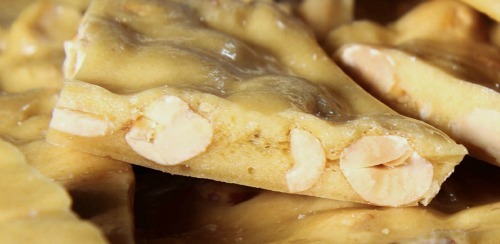
The sugar will be cooked to 300ºF (149ºC)—hard crack stage; which when set up would be hard like a lollipop. But peanut brittle is delicate and you can easily bite into it—how? The secret is in the baking soda.
As the sugar is cooking and begins turning amber in color it accumulates small amounts of acid, and that acid reacts chemically with the alkaline baking soda releasing about a zillion minuscule bubbles of CO2 that get trapped, making the sugar porous and, well…brittle.
Adding the baking soda at the end is important because you need to wait for enough acid to accumulate, and the candy needs to be poured out onto the prepared pan to set up as soon as the chemical reaction occurs. Aeration of the sugar will cause the clear, glassy syrup to turn opaque immediately, and it will increase in volume—so be sure to use a saucepan large enough for the job.
In our post, Caramel Apple Perfection, we introduced the topic of cooking sugar. The same principle of reducing the incidence of crystallization is important with this project. Corn syrup helps to catalyze the sugar inversion in this recipe.


0 comments