

If you spend a lot of time thinking and learning about sandwiches, you'll eventually come to the conclusion that your life just won't be complete without the ability to make perfect deli meats at home. Think of it! Perfect, sliced pastrami layered on homemade rye bread. Smoky ham with pickles, coarse mustard, and melted swiss. Italian beef, spicy with giardiniera. Beef on weck—horseradishy. Homemade French-dip sandwiches.
Why not? Why not have all the sandwiches, even though you don't live in Chicago, Buffalo, or France? (Isn't that where French dips come from? No?) But if you're buying your roast beef from your grocery store deli, you can only get so fresh, so high-quality cuts. And you can generally forget pink, medium-rare beef. Ham, yes, but good roast beef? Hardly.
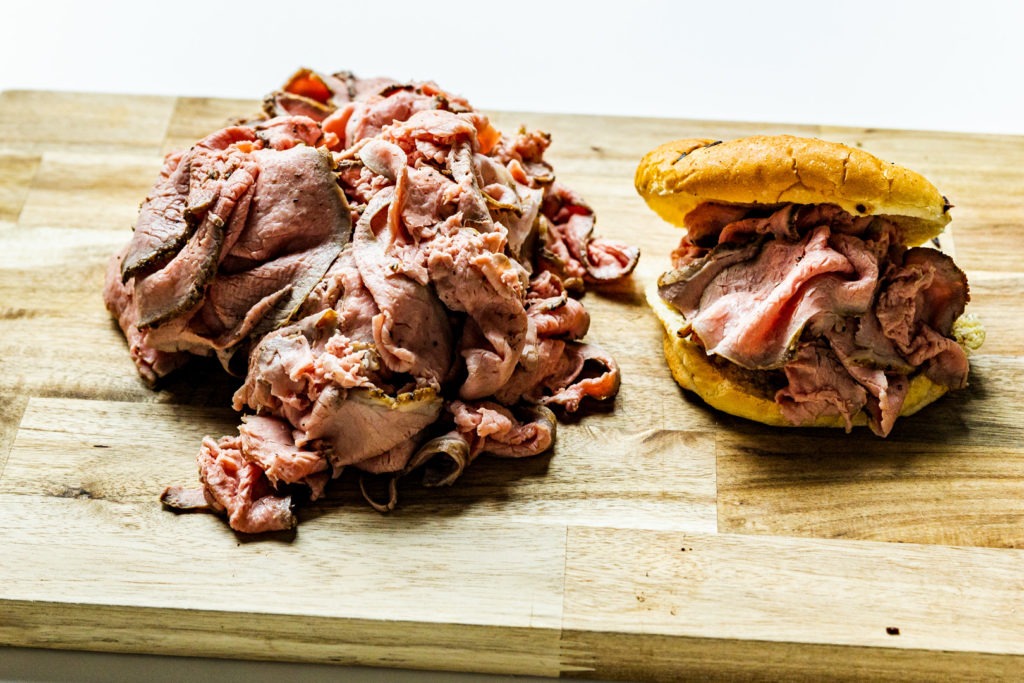
Yes, the sandwich life demands better meats. It demands you make your own. Here, we'll show you the basics of making deli-style roast beef at home. It is, of course, a temperature game—but it's one that's easy to win. We'll take you all the way through the process, and by the end, you'll be thinking about how shelling out $3–11k for a vintage-style, hand-crank deli slicer doesn't sound all that bad. (Don't do it...you don't need it.)
What beef to use for homemade deli roast beef?
There is a little debate about the best cut for deli roast beef. The main contenders are top sirloin, the eye of round, and top loin (also called strip loin). (Some might argue for chuck or brisket, but for plain roast beef, those aren't the right answer. Brisket is great for pastrami and corned beef, but for rare or medium-rare roast beef, stick to the leaner cuts with big, beefy flavor. Save chuck for other things altogether.) Top sirloin is full of deep, mineral, beefy flavor, and is a great contender. Strip loin would be obviously delicious, but it will also cost a good deal more than eye of round or top sirloin.[footnote]Making your own deli meats should save you quite a bit per pound, by the way. Maybe you can use that fact to justify a slicer![/footnote]
Eye of round has plenty of beefy flavor, is wonderfully lean, and has a pretty uniform shape. It's kind of perfect for this project. I recommend you start with eye or top sirloin. Maybe get a strip loin for some very special sandwiches.
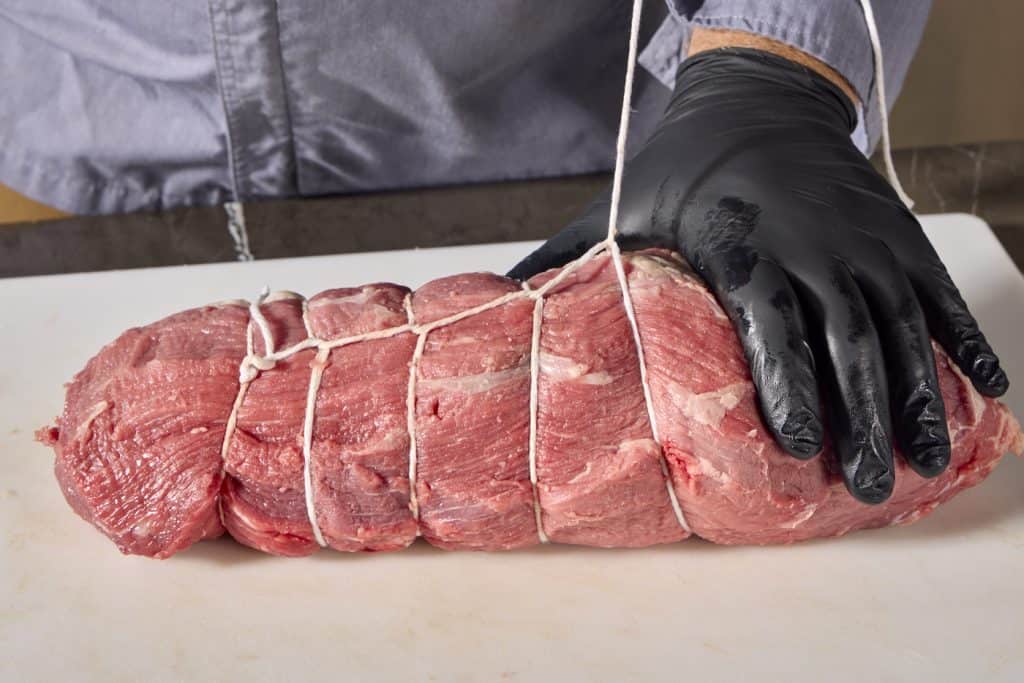
If you remember and have time for it, salt your beef roast, uncovered, in the fridge the night before you cook. This dry-brining will help tenderize the meat and make it juicier while also deepening the flavor.
How to cook deli-style roast beef
For the best roast beef, you want two things in your cooking: a quality sear and a perfect pinkness from edge to edge inside the roast.
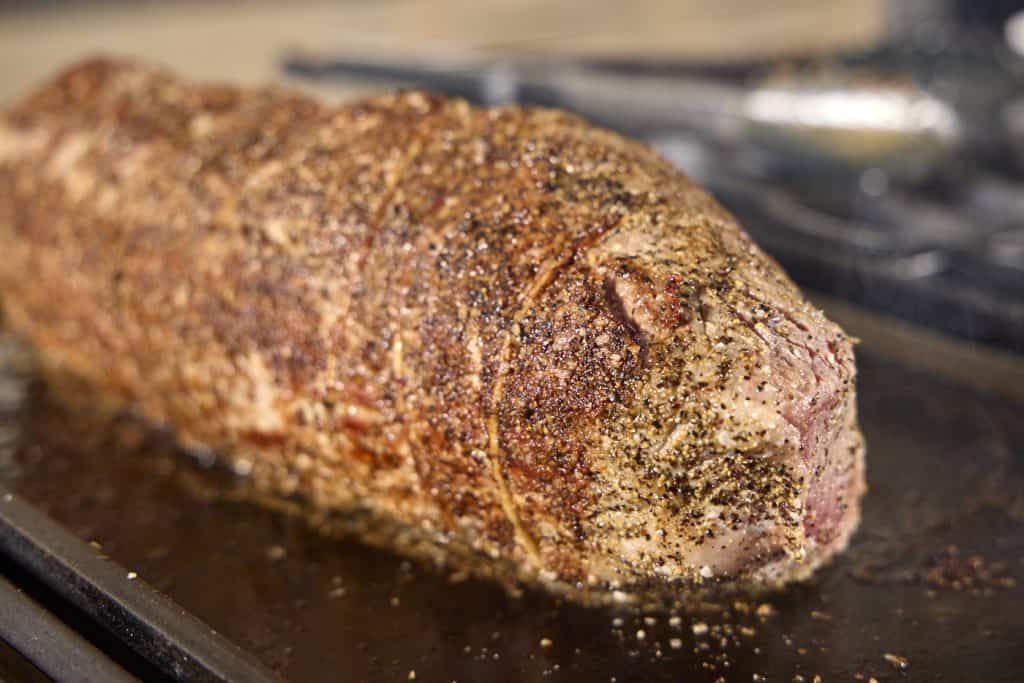
The sear will give a deeper, meatier, roasted flavor. Without it, it's just beef, not roast beef. And while there's not a lot of that roasted portion on any given slice of beef, it's essential for the right flavor. To get the sear right, heat a heavy skillet[footnote] cast iron is best if you have it[/footnote] over high heat, put a little high smoke point oil in the pan, and sear all sides of the roast hard. Get a nice, rich brown on as many sides of the meat as you can. It doesn't matter that the crust may fade during cooking; after all, this is going to be sliced very thinly.
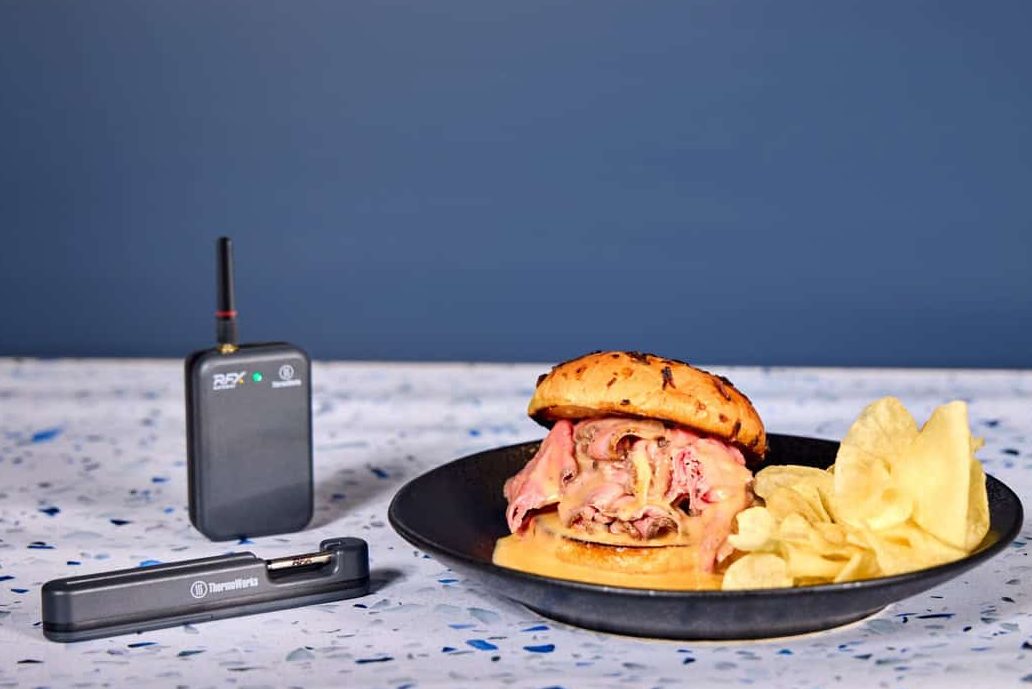
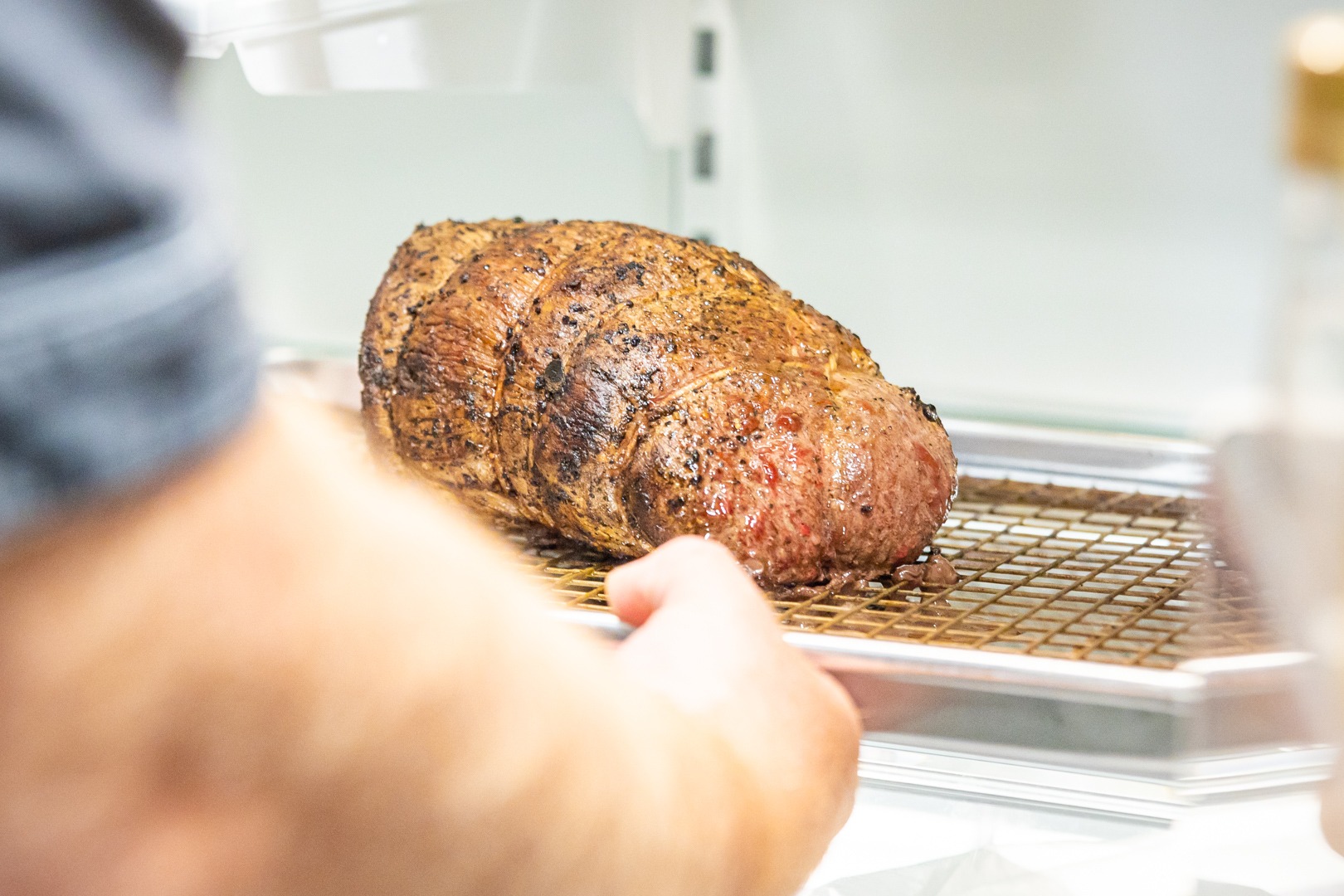
As for the perfect rosy color, that's easily accomplished by slow-roasting the beef. This has two thermal advantages. The first, most obvious, advantage is that slow-roasting decreases the temperature gradients in the meat, as well as minimizing carryover cooking. That means you're less likely to overcook the meat or end up with an unsightly gray band around the edge of your sliced roast beef. Using a leave-in probe like the RFX MEAT with RFX GATEWAY will help you know when to take it out of the oven so that it's temperature-perfect every time you make it. Pulling the beef out of the oven at 130°F (54°C) will ensure a beautiful medium-rare after the 3–5°F (2–3°C) of carryover cooking you can expect from this roast.
But there is another advantage to lower, slower roasting—enzymatic action![footnote]Speaking of low/slow, if you wanted to smoke the beef for your roast beef, that'd be delicious. Follow the same temperature protocols, just change the cooking location from oven to smoker.[/footnote] As red meat comes up to temp more slowly, there are enzymes that activate and break down tougher connective proteins in the meat. The more slowly meat moves through the enzyme-activity zone, the more tender it will become. This is great because top sirloin and, especially, eye of round are not the very tenderest cuts on the cow. A slow roast at 200°F (93°C) will give you the perfect bite and texture for your sandwiches.
Cooling and slicing
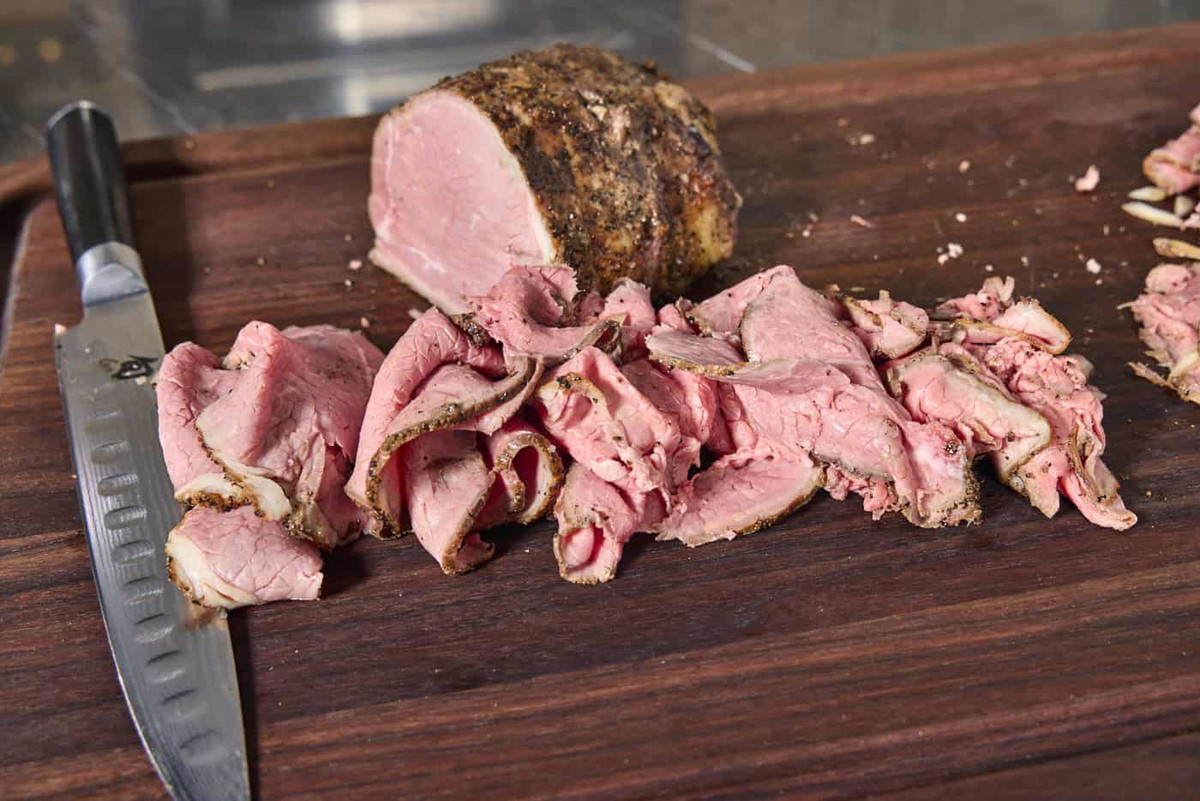
They aren't called "cold cuts" for nothing. Deli meats are kept cold not only to keep them from spoiling, but also because they cut better when cold than when hot. When a roast cools completely, most of the juice is locked back into the protein structure, and the cold fats become solid. The whole structure is more amenable to slicing than when the roast is hot.
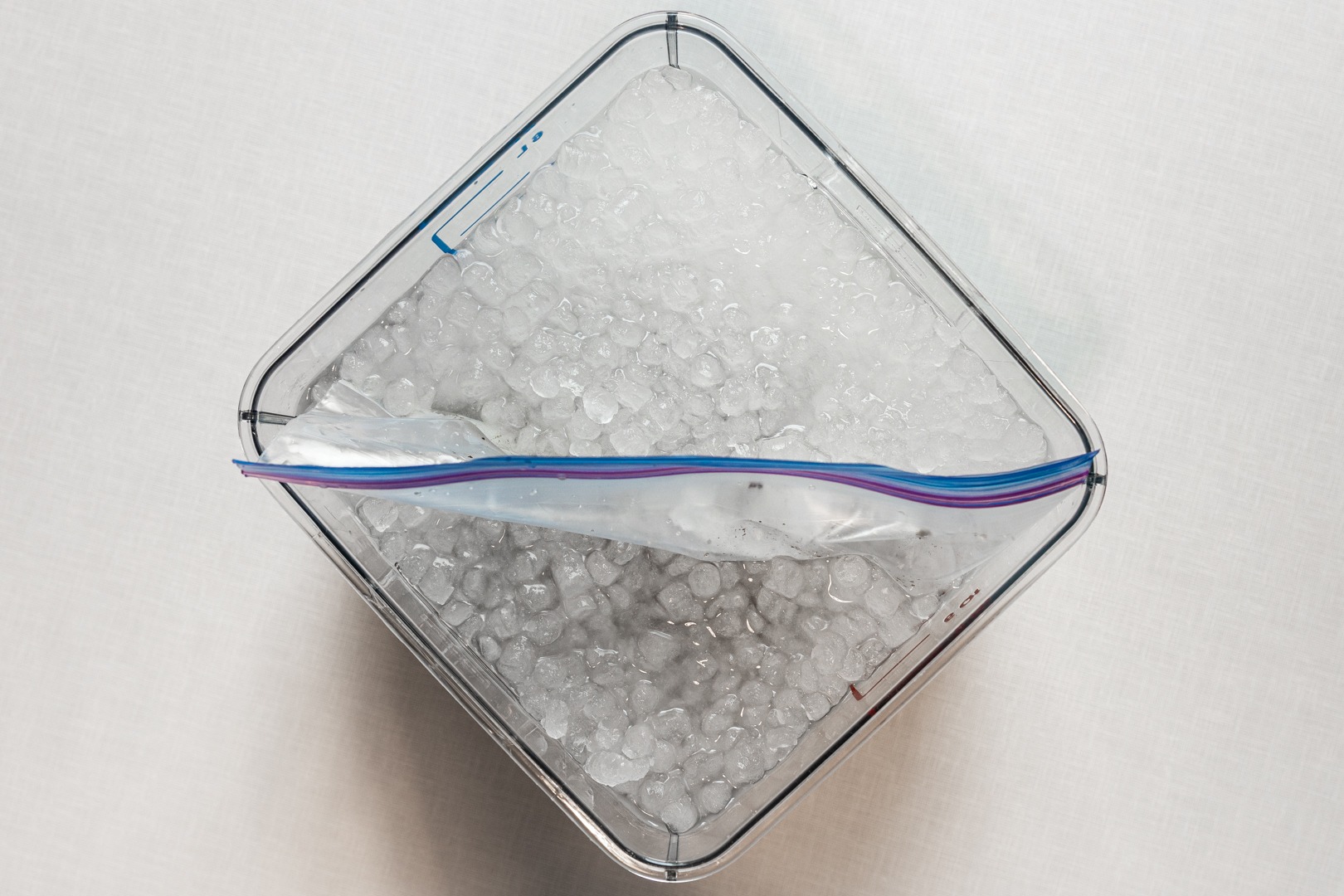
To chill your roast for slicing and for storage, you can simply let it stand on the counter until it nears room temperature, then move it to the fridge for 3-5 hours or overnight. For food safety purposes, get down to 70°F (21°C) within two hours, then get it below 40°F (4°C) within four more hours. The graphing function and the low-temp alarms on RFX MEAT make that monitoring easy. If you're in a rush, you can seal the roast in a plastic bag and submerge it in an ice bath for significantly less time. There are a few sandwiches that call for hot slicing, but for the most part, cold slicing is the best way to go.
As for the slicing itself, you don't need the $3–11k slicers I alluded to in the intro. I mean, I want one, but I don't need one. You can get a decent deli slicer at many home-good stores, and even some sporting goods stores, for very decent prices. And if you need another reason to get one, consider homemade jerky—just a thought. Because slicers can be cumbersome to get out, set up, and wash, it's not a bad idea to do up a roast or two, slice it all, and vac-pack some for the freezer.
But even without a mechanical slicer, a sharp slicing knife and a deft hand can still get you respectable sliced beef for your sandwiches. Just take the time to focus and do a good job. Your mouth will still thank you.
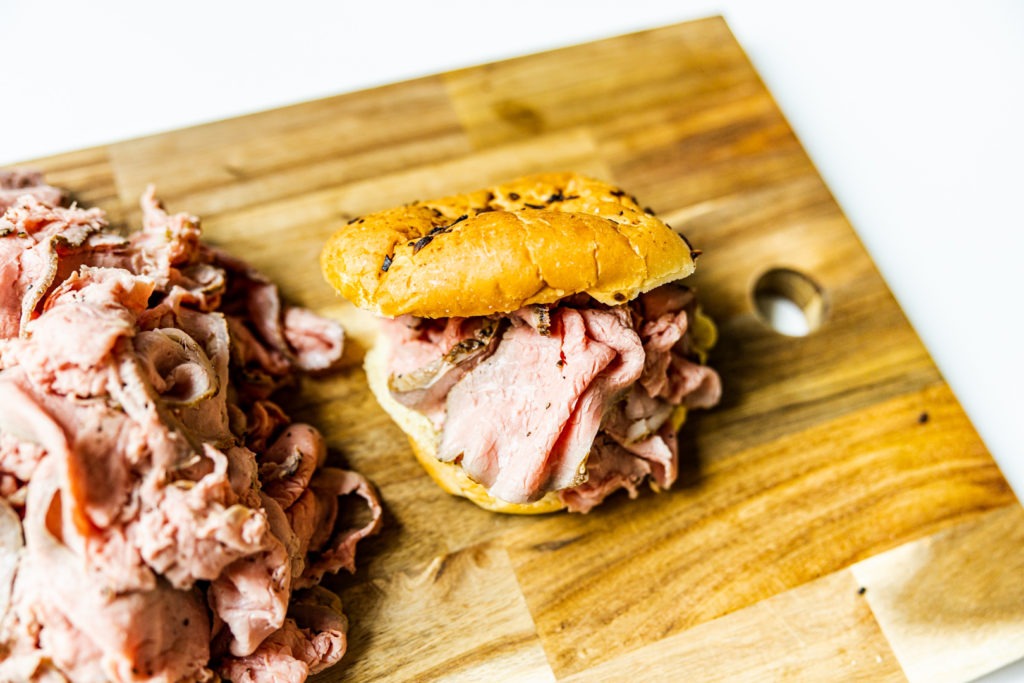
Roasting your own beef is incredible, not just because it's cheaper than deli-bought, not just because it's delicious, but because it's your delicious. Make it to your doneness spec, season it how you like, and get it sliced the way you want it. Make up a whole roast, slice it all, and have Italian beef sandwiches for the family for dinner. Make sandwiches from cities you haven't yet visited. Just load up a hoagie bun for lunch! No matter what, you'll know it's made just how you like it, because you used RFX and Thermapen ONE to make sure the temps were spot on. And when the meat is perfect, the sandwich life really is the life you want to live.
Notes:
If you want to make a sandwich with beef and, say, a cheddar sauce, look at the cheese sauce in our post on melting cheese for nachos for a good starting point that you can modify to your liking.
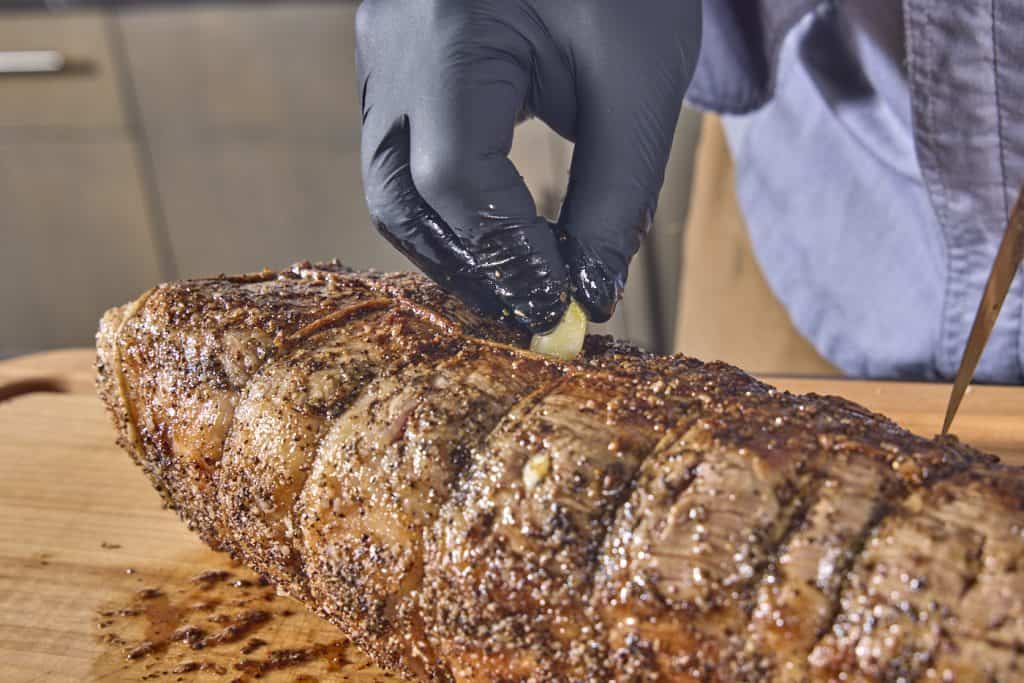
We made our roast garlicky by inserting most of a head of garlic into it after searing but before roasting. We peeled and slivered all the cloves, then shoved them into slits cut in the beef with a pointy knife. Optional, but very tasty.


0 comments