

Kielbasa. I mean, do I even need to write an introduction? Do I need to find some central metaphor around which to construct this narrative? What more can be said than "smoked homemade Polish sausage"? But paragraphs need writing, and blog posts need starting, so here we go.
Fresh-ground kielbasa temp: 150°F
Kielbasa is an essential ingredient in my kitchen. It can be used as a seasoning, sliced and browned before adding to another dish, or griddled up and served as a main next to roasted potatoes and sweet/sour red cabbage. But I have often been stuck with sub-par store-bought over-processed kielbasa. Why do I do that to myself? The homemade article is far better, more subtle, more true-flavored. So we made some, and we think you should too. Use our temperature tips and the family recipe from Ethan Chlebowski, you'll end up with a sausage that will leave you in a place that needs no words to describe it.

What is kielbasa?
Sometimes I write question headings like that, imagining that you, the readers, might be asking that question. I do not imagine that to be the case here; in fact, I assume you probably know and love kielbasa. But I think there are still some interesting things to be said about it.
It is pretty common in America to use the terms "kielbasa" and "Polish sausage" as synonyms, which is interesting because the word kielbasa is just the Polish word for sausage. If you were to travel to Poland and ask for kielbasa, they'd probably ask you which kind you meant, for, indeed, there are dozens—no, hundreds—of kinds of kielbasa in Poland.
What we, here, refer to as Kielbasa or Polish sausage is most closely related to the wiejska kielbasa, basically translated as "country sausage." It is the rustic sausage of farmers and villages, often smoked and seasoned, mainly with garlic and marjoram. This is the sausage that was brought to our shores by Polish immigrants and took hold even outside the immigrant communities.
It's delicious. It shines sliced and browned, split down the middle and grilled, used as an ingredient in soups, stews, pots-o'-beans. And of course, it's amazing simmered/braised in sauerkraut in its own right or as part of the traditional Polish Bigos (hunter's stew).
Making Polish sausage at home
Cut and chill
The process for making this "Polish sausage" at home is very similar to any other fresh sausage recipe (like our bratwurst and andouille recipes). First, the meat is cubed and chilled in the freezer so that the fat will cut cleanly. It's a good idea to also chill your grinding equipment. In our case, we did the whole process outside in 30–33°F weather, which kept the equipment [footnote]and our hands[/footnote] from overheating very nicely.

Measure seasonings
Ok, there is actually another step here, and it's math. The recipe for this (and many other) sausages is given in percentages. You weigh your meat and multiply by the percentage to find the weight of your other ingredients. For instance, this recipe uses 1.75% salt, so if you have 1,245 grams of meat [footnote]grams is easier to work in because the intra-system conversions are much cleaner[/footnote] you'd multiply 1,245 by 0.0175 to get your salt content (divide the percentage by 100, then multiply that number by your meat weight):
1,245 g * 0.0175 = 21.8 g
1,245 grams of meat calls for 21.8 grams of salt. I'd go ahead and round that up to 22 grams because 0.2 g of salt isn't going to matter much and because my scale doesn't measure tenths of grams. Before you can mix the seasonings with the meat, the seasonings all have to be calculated, weighed, and combined. (Note: the recipe calls for pickling spice. We combined it with a little of the salt in a spice grinder so be sure that none of those potent spices ended up coming through the grinder in still-unpleasant chunks.)
Season and grind
Ready the seasonings, then combine them with the meat. A large bowl is great for doing the kind of tossing and flipping and smooshing you'll need to do. Make sure everything is well distributed.
Then comes the grinding, of course. If you have a stand-alone grinder, great! If you have an attachment for a stand mixer, wonderful. If you need to pulse the meat in batches in a food processor, well, homemade sausage is worth a lot of work, so go for it. If you have to chop it by hand with cleavers you have my best wishes, but it will work. (Maybe consider using pre-ground pork?) A medium grinding plate is just right for this operation, though a coarser plate would not necessarily be amiss. Grind it all up with the seasonings.


Mix the sausage
Once ground, the meat must be mixed with some water. The added water will help the flavors distribute more evenly, will help the meat through its myosin formation, and will make the stuffing step easier. For our ~6 lb of meat, we used just over a half-cup of water, but this is more of a by-feel thing. You need enough water to allow the meat to move and to agitate against itself, but you obviously don't want to make soup. Add some water, mix the meat until it is sticky and fibrous looking. This step of partial emulsification will help the sausage hold together in a more sausage-y consistency and will keep it moist when cooked.


If you've kept everything cold, as you should through this process, then mixing by hand will be cold. I had to use some insulating gloves usually reserved for grabbing hot shoulders from the smoker to keep my hand bones from aching, a cheat I recommend to you. Or I guess you could use a stand mixer.
Once the sausage filling is ready, it's time to stuff. If you're going to make a lot of sausage in your life, I very much recommend getting a dedicated sausage-stuffer—you can stuff five pounds of sausage in a matter of a minute or so. If otherwise, use the sausage stuffing gear associated with your meat grinder. We used natural hog casings, super traditional, but you can use collagen casings or whatever else you like. Heck, use sheep casing and make extra thin kielbasas if you want. It'll be fun.

Don't overfill the casings, and try to prevent air bubbles from forming. (If they do form, prick them with a pin or, I don't know, maybe a Thermapen® probe.) Twist the sausages into about 10-inch lengths and cut the links up into joined pairs.
Drying
Here's where the path for kielbasa diverges strongly from, say bratwurst. Before the sausages are smoked, they are hung to dry the exterior. You want the casing, which is probably slippery after stuffing, to become dry to the touch. Use a clean broom handle or another stick-thing suspended over a couple chair backs and hang the sausage pairs over it. If you're inside, setting up a fan pointed at the sausages to provide circulation is a good idea. We were outside and there was a 32°F (0°C) breeze coming through the ThermoWorks BBQ courtyard, so we didn't need a fan. Let it dry for about an hour, or less if they dry out more quickly.

Smoking homemade kielbasa: the temperatures
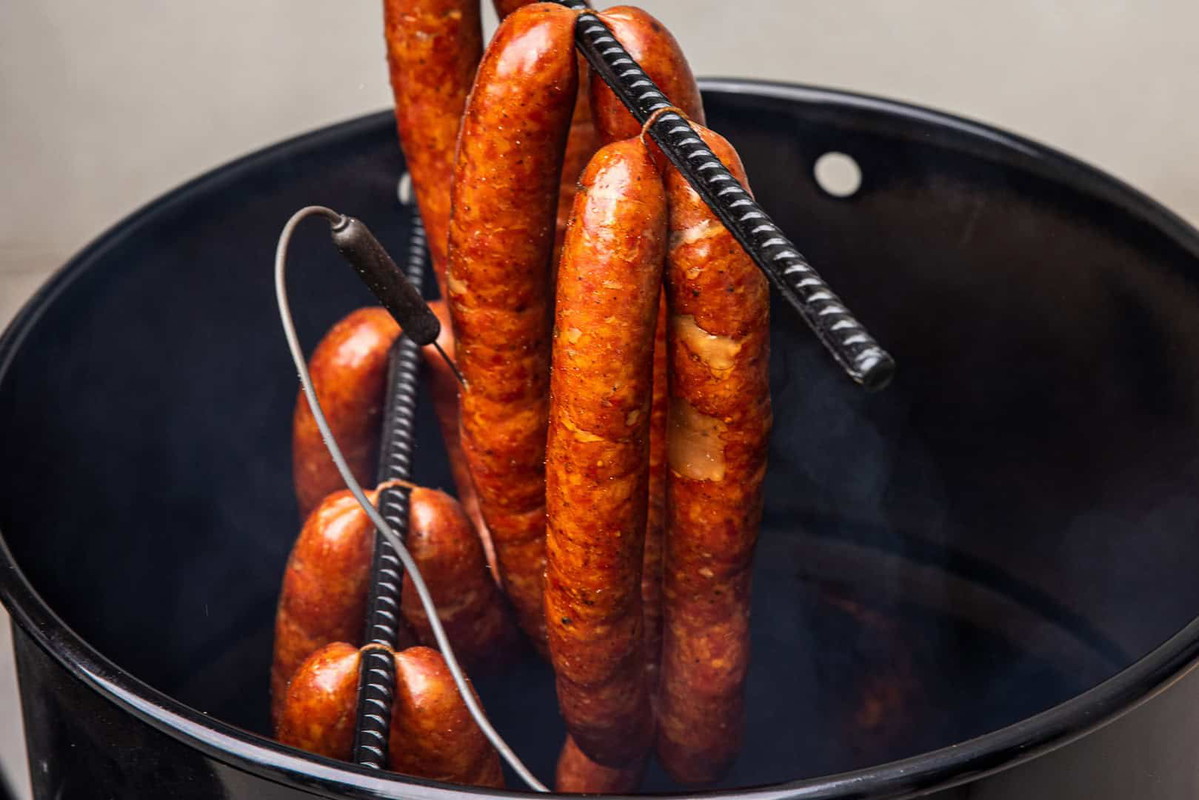
Finally, we come to the actual smoking. Kielbasa needs smoke both for flavor and for color (that beautiful red sheen is due to the curing salt and the smoke interacting with each other). The temperatures here, though, are important. We want to run the smoker at about 250°F (121°C), a temperature you'll want to monitor with the air probe from your Smoke X2™.
As for the sausages themselves, we find ourselves in an interesting position. Because we ground the meat fresh, we can ignore to some extent the rules regarding cooking ground meats, which usually have us pushing our grinds to 160°F (71°C). We can bypass that requirement, though, by fresh grinding our meat. Our critical temperature target for these sausages is 150°F (66°C), a temperature we will monitor with the Smoke X2 and the optional Pro-Series® Waterproof Needle Probe. Not leaving anything to chance, we'll also verify that temperature with a Thermapen®, to make sure we haven't missed a cooler temperature in the sausage with the leave-in probe. The smoking took us about 45 minutes.

Once the sausages are cooked, pull them from the smoker and give them a spritz with some cool water. This process, called "blooming" the sausage, is supposed to help the color develop, arrest the cooking, and help rehydrate the skin on the sausages. Congrats, you made kielbasa!

Once you've made these sausages at home, it'll be hard to go back to the industrial-grade version from the store. Do yourself a favor and try them served simply on a bed of good sauerkraut, maybe that has been simmered with some bacon (home-cured?) and a splash of white wine. Make a large batch, then vac-pack to keep it on-hand in your freezer to pull out a link or two at a time as you need them, and your whole kitchen life will get better. I know sausage making can seem daunting, but it needn't. With our temperature tips and tools, like the Smoke X2 and the Thermapen, the only thing you have to worry about is a wee bit of math for your spices. And once you crack the code and discover you can make something you always bought … well, there are hardly words to describe how good that feels.



0 comments