

Though brisket and ribs tend to get all the attention, we love a good hot link sausage when it's time for BBQ. Who wouldn't?!? They're über-flavorful and they tend to exhibit a little more differentiation from BBQ joint to BBQ joint. At every roadside BBQ stand, the question of how the sausage will taste looms large. Will there be fresh jalapeños? Cheese? Loads of garlic? Cayenne?
In this post, we'll go over the basics of hot link sausage so that you can make your own, and, more importantly, make them your own. The best BBQ sausages in town are about to be found in your kitchen. Let's check it out.

What are hot links?
Hot links are a common part of Southern cuisine, with variations in flavor and method spread across the South. They are generally seasoned with a lot of cayenne or other red pepper, tinting them red—and lending to their name. Hot links are not necessarily super spicy, but they are heavily seasoned. In many ways, they are not dissimilar to Cajun Andouille. In this post, we're focusing on a version that is more classically Texan than anything else, and that means beef. Yes, some hot links are beef and pork, but the Texas version is usually all beef, and at BBQ joints, it’s usually made from brisket trimmings.
Hot links are also often cured. Part of their vibrant color comes from the pepper, yes, but part of it also comes from the curing process, which changes the protein structure so that the meat doesn’t brown when cooked. The sausage needs to cure overnight with the curing salt before smoking.

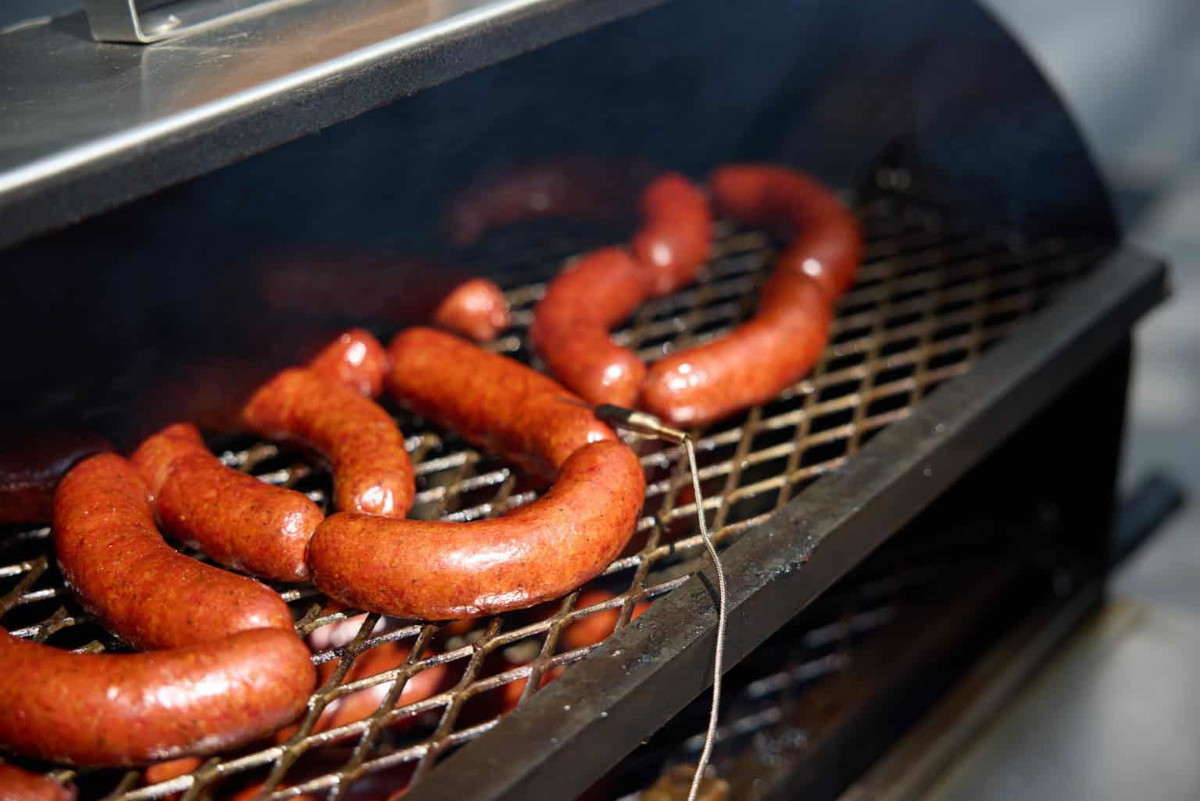
Ah yes, smoking. Not all hot links are smoked, but these ones, and many in Texas, are. In order to get the smoke flavor down into the meat through the sausage casing, they need to smoke for a while, so we'll be smoking them at about 180–200°F (82–93°C), a temperature that is low enough that the sausages, with their small thermal mass, can undergo in the smoker for longer without overcooking. (And it doesn't hurt that more smoke is produced at that lower cooking temperature.)
Hot links are often sold (or made and stored) fully cooked—the smoking is a part of that process.
Thermal considerations: Hot link sausage temps
Making temps
There are a few temperatures we need to watch out for when making hot link sausage. First, chronologically, is the temperature of the meat while we're making it. In order for the meat to properly emulsify, and to maintain proper food safety while working it, the beef needs to be kept at or below 40°F (4°C). Start by cubing the meat and putting it in the freezer for 15–30 minutes to chill and firm up. The firmer meat will grind better and be less likely to "smear." Chilling your grinding equipment before you start to grind is also a good idea. If you worry that your meat may be getting too warm, check it with your Thermapen® ONE. If it’s too warm, toss it in the fridge for a few minutes.

Smoking temps
Then there are the smoking temps. As we’ve already said, we want to smoke these very low and slow. Some people even cold-smoke them before hot-smoking them to cook them through. Use a leave-in probe thermometer, like Smoke X, to monitor your pit temp during smoking to make sure your links get well smoked.

Sausage doneness temps
Finally, of course, there is the doneness temperature. Sausage is, by definition, ground meat, so the chance of bacterial contamination is not insignificant. And though they are cured, they are not bacteria-proof. So we need to cook them to 160°F (71°C). Use a thin probe, like the 2.5” needle probe, to keep an eye on the sausages, and set your meat-channel high-temp alarm on your Smoke X2, then verify the doneness temp with your Thermapen ONE.

Ice-bathing the sausages
One final thermal thought before we move on. If you’re smoking your sausages to save for later, perhaps vacuum packing them for freezing, or just getting them ready to eat tomorrow, you’ll want to plunge the links into an ice bath for a few minutes. This arrests the cooking and prevents some degree of shriveling. And they’ll be ready to pack and freeze sooner.

Customizing your hot links
This recipe is a great one, adapted from Chuds BBQ and GirlsCanGrill, but it can be just a starting point for you. Mix up your meats—toss in some venison, for instance—or tweak the seasoning a little at a time. Up the heat with more cayenne and less paprika, or add a little dried marjoram for a more Polish-y taste. It’s all yours to modify and change to your liking. (Just don’t mess with the curing-salt-to-meat ratio. That one is chemistry and is very important.)
Then slowly smoke whatever you’ve created, pull it at the right temperature, and enjoy the best hotlinks you’ve ever had … because you designed them to be just what you like. Happy cooking!


0 comments