

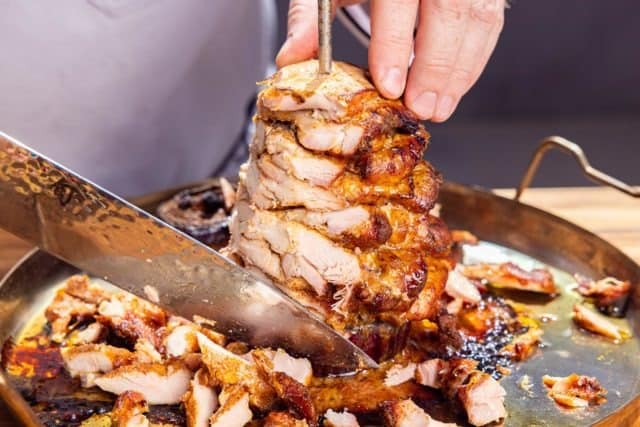
We've written about chicken shawarma before, but we thought it would be fun to try cooking an actual shawarma … or at least as close as we could get without buying a whole apparatus that actually turns and cooks. So to that end, we took a look at our recipe and decided to use our vertical spit Trompo King to try to make something closer to what we love about the popular street food. Of course, this necessitated a change in thermal thinking, but thermal thinking is our thing, so that wasn't a problem!
Here, we give you the instructions and thermal tips you need to make, frankly, one of the most beautiful and fun summer dishes we've made in a long time. Join us, and let's cook something wonderful!

Shawarma review—what is shawarma
Shawarma comes, originally, from the Ottoman empire. Its name comes from the mode of cooking, a slowly spinning vertical spit. It is often made with lamb and/or beef in Middle Eastern countries, but chicken is also popular around the world. We're excited to make a version that has the vertical spit component, one that we can slice off of, that has tasty crispy bits on the outer edges. Even though our spit doesn't rotate on its own, it's still closer to the real thing.

To achieve an authentic shawarma flavor, a blend of spices is used, including cumin, coriander, paprika, and some cinnamon. The flavors can be elaborated on—adding fresh herbs, increasing the spice level, etc.— but the just-warm flavor we present here is plenty good without any embellishment.

Shawarma is often served in a fresh, warm flatbread right out of an oven. (By all means, make some fresh pita, if you want! But if you're not going to do that, use a warmed-up pita from the store.) It also often has a yogurt or tahini sauce, and we've provided a sauce recipe that combines both those flavors for maximum tastiness.

Using a vertical spit: thermal principles
Stacking all the meat for this dish on a spit—packing it tightly together like that—creates some interesting thermal situations that we don't face if we grill the thighs separately. After all, we can't pump heat quickly into individual pieces of chicken when they're all clumped together like this.
So what does that mean? First, we need to think about doneness and safety.
Doneness/safety temperatures
With chicken that has been swimming in a marinade overnight (an overnight marinade is best!), we need to be especially careful of food safety. You may know from any of several of our former posts that chicken cooked to a lower temperature than expected—157°F (69°C)—is actually safe! Well, it is as long as it spends a little time at that temp. But a chicken tower like this won't quickly cool down. So we know that for safety we need to get this meat stack up to 157°F (69°C).
But this is, of course, chicken thigh. Breast dries out too easily, and if we used it, the crispy bits on the edges would be more like jerky than crisp-juicy chicken bits. Thighs have more connective tissue, and more fat stores to combat overcooking. But that also means they need to cook to a higher temperature. We usually recommend an internal temp of 175°F (79°C) for chicken thigh, but in this case, where we have a solid cylinder of meat that takes longer to come up to temp, we recommend a pull temp of 165°F (74°C). By the time the meat gets up to that temperature, it will have had plenty of time to tenderize. Going longer is just delaying dinner!

To make sure you hit those temps, you need a leave-in probe thermometer. (Cutting the stack open to see if it "runs clear" never works, but works especially poorly here.) A BBQ thermometer like Smoke™ Remote BBQ Alarm Thermometer is perfect for the job. You can use the included air probe to keep track of your cooker temp—which should stay between 350 and 357°F (177 and 191°C). And you can use the other included probe for the chicken, or as we did, use a different Pro-Series® probe, like the High Temp Straight Penetration Probe. Then, when your Alarm sounds, you can verify your chicken's temperature with your Thermapen® ONE.

Crispy shawarma bits
One of the appeals of shawarma is the slightly-overcooked, crispy bits that form on the edge of the cone of meat as it cooks. This cook is done over indirect heat, optimally with the heat source coming from one side, rather than underneath (though a cook in a kamado with the deflector plate is great, too). To get an even crisping of the edges, turn the spit manually every 30 minutes during the cook. The result is beautifully browned, delicious meat all around the spit, even though it wasn't turning throughout the cook. A timer that is easy to reset to the same time over and over, like TimeStick® is ideal for this task.

Note: If you don't have a vertical spit, you can just grill the chicken thighs on their own, then chop them up. Just use your Thermapen ONE to temp the individual thighs as they cook. It's not quite as fun a presentation, but it's still great for flavor!
Shawarma toppings
As we noted above, yogurt sauce is common, and one with plenty of fresh herbs, mint and dill, is best. Beyond that, you also need some veggies. Fresh tomatoes, cucumber, lettuce, and crisp/bright raw onion are all welcome. So is a sprinkling of goat cheese or feta. And don't forget to pass around some chili sauce to top it with, too! Pile it all on a warm flatbread and you'll forget about any other meals.

We can't say enough how delicious and fun this cook is! Chicken shawarma is incredibly fun to stack the meat, to turn and slice it off the edges as you serve it. And with this killer yogurt sauce, it's even more fun to eat. If you don't have a vertical spit, you might want to get one just for this dish! We hope you try it and that you like it, and that sharing it with friends will bring them the same kind of joy you had when cooking it. Happy cooking!


0 comments