

Homemade grilled burgers are the prize of the summer cookout table. Infinitely customizable, they are great for a party with a variety of tastes. But a dry, flavorless burger is a (semi-)tragic disappointment. Now, we are HUGE fans of smash burgers, with their lacy edges and high crust-to-meat ratio, but sometimes, man, we just want a big, thick, juicy, meaty burger. So how do we make a thick, juicy burger on the grill and avoid puck-like meat patties? Well, we need to grind our own meat, and we need to watch the temperatures. Let’s take a look!

Keys to the best grilled burgers
When we look for a thick burger, we think of 4 things:
- Flavor: We want full, rich, beefy flavor.
- Brown Crust: A good burger has a crisp-seared, flavor-packed exterior (thanks to the Maillard Reaction).
- Juicy: Give us meat that is so moist it’s practically dripping with every bite.
- Tender: Burgers need a texture that is never tough and can be chewed easily.
Everything you do on the way to your plate will affect the burger’s outcome, but it’s nothing that some temperature control and a bit of know-how can’t handle. Let’s start with one of the best things you can do to better your burgers: grind your own meat.
Grinding your own burgers
The quality of your hamburger all starts with the meat you choose. Experts agree that the best burgers are made with freshly ground meat. With commercially pre-ground meat, there isn’t any way to know which cuts were used—and it often isn’t the nicest bits. The texture of the final product is usually more dense and chewy, and lacks rich, beefy flavor. When you grind your own hamburger, you’re able to choose the exact cuts you want for their flavor and fat content. And when selecting cuts, keep in mind that the overall composition of the meat needs to be about 80% lean, 20% fat. Having small chunks of fat “marbled” throughout the ground meat produces pockets of moisture and flavor that are necessary for a good bite. In Kenji’s post, What’s the Best Way to Grind Beef?, he recommends beef chuck, sirloin, and brisket flat as great candidates for their flavor and fat. Other great options are beef short ribs and beef cheeks—both of which are exceptionally rich and flavorful.

Grinding your own burgers and food safety
But let’s go beyond flavor and texture. Let’s talk about safety and juiciness. Ground meat must, according to the USDA, be cooked to 160°F (71°C) to reduce the risk of bacterial infection, and that’s because harmful bacteria exist on the exterior of whole-muscle meat. Then, when the meat is ground, the surface bacteria distribute through the whole mass, contaminating all of it. If that meat sits for any appreciable amount of time before cooking, the bacteria can colonize easily. That factor, plus the mix of several small cuts that goes into supermarket ground meat, raises the risk of contamination.
But burgers are best and juiciest when they are cooked to 130–140°F (54–60°C).
By grinding our own meat fresh, we reduce bacterial colonization time and control which muscles go into the burgers, allowing us to (more) safely cook our burgers to a lower temperature. (For more detail on how to safely cook your burgers, check out our post, Moist and Flavorful Burgers That are Also Safe to Eat.)

How to Grind Hamburger at Home
Keep the meat for grinding cold
Regardless of the grinding method you use, you must keep the meat and all equipment cold! Room temperature meat will smear the fat and connective tissue, rather than cutting it. And warmer meat also invites bacterial growth more readily. The goal in grinding is to have separate and identifiable small chunks of meat and fat, not a smeared paste. Freeze your meat grinder parts for 1–2 hours before grinding. (Professionals who regularly grind meat store the equipment in the freezer).
For food safety, care must be taken to keep the meat at or below 40°F (4°C) while being processed. If the equipment or meat get too warm, return them to the freezer for 10–15 minutes.
To prep the meat, cut into 1–2 inch chunks, place in a single layer on a parchment-lined sheet pan, and freeze for 15–20 minutes prior to grinding. Pull the meat from the freezer when all of the equipment is ready to go. The meat should go straight from the freezer to the grinder or food processor. Neither the meat nor equipment should rise above 40°F (4°C) during the grinding process. If you’re grinding a large quantity of meat, periodically refreeze it to keep it cold, and only pull out small quantities of meat from the freezer at a time.
Using a meat grinder
This is a great all-around method for grinding any type of meat. The texture is loose with plenty of nooks and crannies for collecting juices. Be sure the grinder blade is very sharp. A dull blade won’t cut cleanly through all of the tissue, smearing the meat instead. Again, be sure it’s cold throughout the process!

Making big, juicy beef patties
For the most uniform hamburger patties, weigh the meat on a digital scale before shaping. To end up with 6-ounce patties (nice, thick ones), start with patties that are 7–8 ounces. Use a scale to get the portions right, and you’ll have more uniform burgers that will cook at the same speed.
Shape burger patties loosely
Packing the meat loosely leaves pockets of space where the burger can hold onto its juices and rendered fat, and the jagged edges of a loose burger expose more surface area to create more crisp, brown crust on the exterior—yum! When ground meat is packed too tightly, the patty will become dense with little to no pockets for collecting juices, and the connective tissues will bond together like velcro, yielding a tough and chewy burger rather than a tender one. The web of connective tissues will also cause the burger to shrink during the cook as they tighten.
Dimple the patties: Making a slight indentation in the center of each patty before grilling will keep the burger from developing a domed shape. The connective tissue in the meat shrinks and tightens at temperatures above 140°F (60°C). The meat touching the high heat of the grill will contract while cooking, and the dimple will help it to maintain a uniform shape. It really works!
Salt at the right time
Salting steaks before cooking dramatically improves their flavor, texture, and ability to retain moisture. But salting burgers before patty-ing them kind of ruins their texture. And salted-then-mixed meat easily becomes dense and tough when cooked. The best time to season your burger is right before it hits the grill.

What temp do we grill burgers at?
Cooking over high heat is essential to developing the flavorful dark brown outer crust of a burger, but it can also overcook the meat. In Master of the Grill, the cooks at America’s Test Kitchen define grilling as a quick-cooking method at temperatures ranging from 400–600°F (204–316°C). Since the Maillard Reaction rapidly goes into action at 350°F (177°C), this is an excellent cooking method to obtain a flavor crust on meat. Burgers are thin enough that quick, high heat works very well to arrive at the desired pull temperature in one step on the grill without overcooking. But searing at high heat after cooking gently at lower heat is also a good call; reverse-seared burgers are some of our favorites.

Use thermometers!
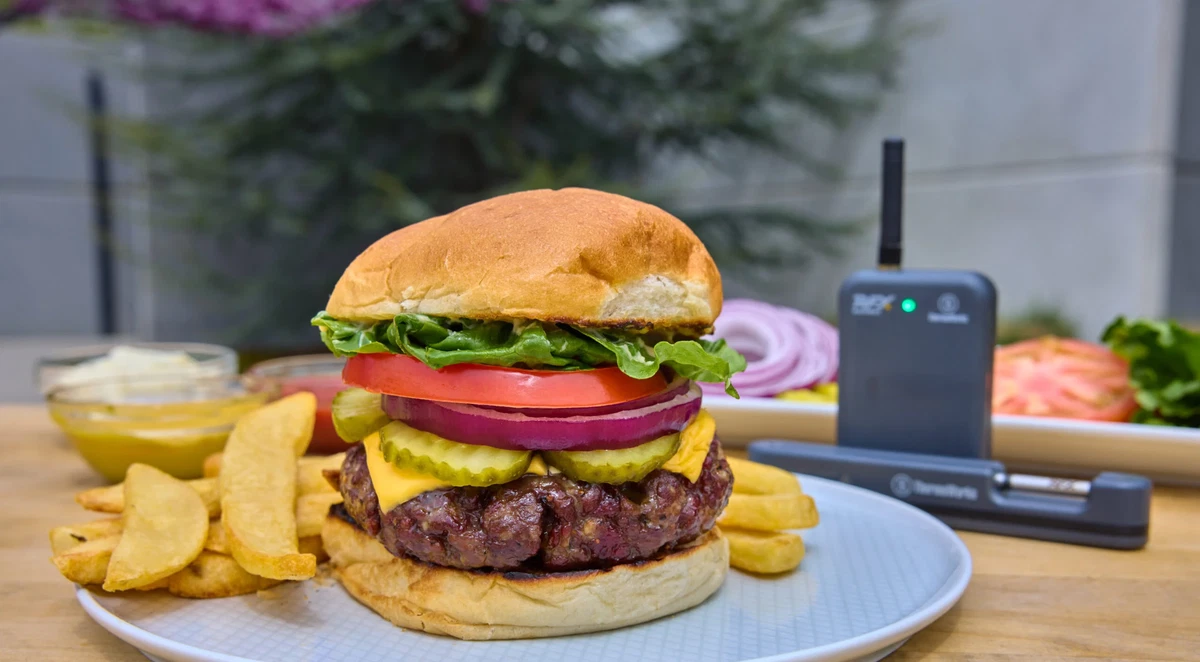
Whether you reverse-sear or go high heat from the get-go, no tricks, no grinding, no salting-care will stop an overcooked burger from drying out. Dry meat is dry meat. So it is essential that you use thermometry when cooking burgers. In fact, RFX MEAT wireless probes are phenomenal for grilled burgers because you can watch the temperature climb on the app while you cook, pulling the burgers if you see the “thermal momentum” rising too quickly. And the 1,000°F (538°C) capability of the probe antenna makes it a go-to for direct-heat grilling. (Just be sure the probe is inserted up to the recommended immersion line with no probe sticking out the other side.) Set your high-temp alarms in the app and watch the burgers cook without having to open the lid!

And of course, Thermapen ONE should be your go-to thermometer for spot checking and verifying temperatures. Full readings in one second and an accuracy of 0.5°F (0.28°C) make checking a whole grill of burgers quick, easy, and accurate.
By grinding your own hamburger, salting at the right time, and grilling with high heat to the correct internal temperature as measured with RFX MEAT and confirmed with Thermapen ONE, you’ll be sure to grill up memorable burgers all season long!
0 comments